News

Blue Door News June-August 2018


Blue Door News, June – August

Dungeness and the National Gallery

The saga of clinic and hospital visits has continued to mark our calendar over the last couple of months. However, in June we managed a few days at Dungeness. It is really a unique landscape, as many will know, full of a variety of wild flowers, grasses, pebbles, and scrubland and the signs of a long-standing fishing culture. Quaint or, in increasing numbers, modernised sheds and cottages are pitched at random across the flat terrain, threaded by the Romney, Hythe and Dymchurch miniature railway (yes, we took a ride), while behind everything stands the Dungeness Nuclear Power Station.
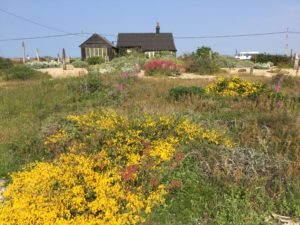
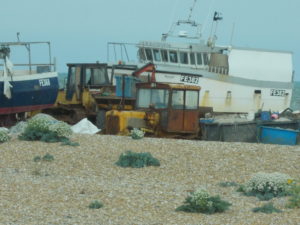
 

We photographed everything and Pete did a pen and crayon sketch of Derek Jarman’s Prospect Cottage. He has also, now in early August, finished an oil painting of a scene commanded by a boardwalk stretching out to the sea.

This is included along with some other new work by us both in the Portfolio under ‘Recent Work’.

July came and went, first hot, then hotter. At the beginning of August we visited two related exhibitions at the National Gallery with American friends. These were ‘Thomas Cole Eden to Empire’ (including his series ‘The Course of Empire’, 1833-36) and the American artist, Ed Ruscha’s ‘Course of Empire’ (1992 and 2005) which clearly alludes to Cole’s series.

Cole was a largely self-taught English-born artist, influenced by Turner and Constable amongst others, who became a premier figure in the American landscape tradition. His ‘The Course of Empire’ depicts the ascendancy and decline of Empire from pastoral idyll to glory, defeat and devastation in large, appropriately epic canvasses. It is seen, as is the major work ‘View from Mount Holyoke’ also displayed in the exhibition, as a warning to America of the impending ruination of its natural riches signalled by the advance of mechanisation and uncontrolled growth. One thing which struck us all was Cole’s depiction of people, always miniature, and given allegorical roles as representing, say, the coming of farming, or art and learning, or the military. Their small size would seem to stand as lesson on the smallness of human society in the scale of things where the natural world is immense but imperilled.

Cole’s ‘The Course of Empire’ consists of five paintings. Ed Ruscha’s ‘Course of Empire’, without the definite article, comprises two series of five paintings each. The first titled ‘Blue Collar’ depicts five black and white canvases of premises in Los Angeles (or strictly the tops of these buildings), a Tool and Die factory, a Trade School, and a Telephone booth, for example. Set below them in the exhibition are depictions of the changed aspect of these same buildings in the present-day, now painted in colour. The logos have faded, The Tool and Die factory has swapped its title for Korean Style calligraphy and a wall of graffiti, the Trade School is boarded up and fenced off, and the Telephone booth is simply defunct in an age of digital communication ousted by a concrete telegraph pole and a tree. Ruscha himself does not own an iphone. Thomas Cole’s ‘hatred of the progress of mankind’, he says, would make him weep at the ‘poetry of change’ witnessed today. Of himself, he says he prefers the black and white world, Oddly enough, this is the ‘blue collar’ world gone missing for supporters of Donald Trump. But if Ruscha is nostalgic for a lost America, Trump is not the answer to present day woes. ‘Oh Boy’, he says in interview at the mention of Trump’s name; ‘the art world is still in shock’ at his election … We’re all sitting in an electric chair’.

Ruscha is probably best known for his homage to US gas stations and it would be good to catch up with this work. Meanwhile, in a critical note, while the present two exhibitions of Cole and Ruscha’s ‘Courses of Empire’ are evidently companion shows, and both splendid, they are installed on different floors some distance apart. There is no encouragement by the National Gallery to see them together, no directions on how best to physically get from one to the other, nor the simple guidance that it would be best to see the Cole first.

August 8th

An uncanny sequence of events: the Summer Special of the New Statesman includes the following poem by Hugo Williams:

Ghost Signs

I was trying to read your mind

in London’s palm, looking for reasons

in the blank faces of shops.

 A ghost sign for REFRESHMENTS

high on the wall in York Way

 and one for WEIGHING MACHINES

 round the corner in Gray’s Inn Road,

  were growing fainter, harder to read.

 The sun was going down

  on The Poor School of Performing Arts,

  Espiritu Santo Hairstyles and Nails,

  “Hurricane Pool Hall Opening Soon”,

   a battered tin advertisement

   spinning illegibly in the wind.

Hugo Williams had earlier written a set of poems on his experience of dialysis and had a transplant in 2014. We read these poems in the LRB and today Liz read his ‘Ghost Signs’ on her way to the Renal Department at Brighton Royal Sussex Hospital and pointed it out to me later. The route Williams takes in the poem was his route to the Dialysis Clinic at St Pancras. But she pointed it out for another reason too. The first ghost sign he describes was the subject of a painting I did last year
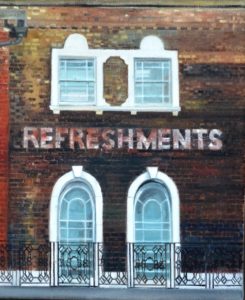
Some kind of serendipitous affinity of one kind and another at work here, it seems. Happenstance, you might say.


Jan – June 2018

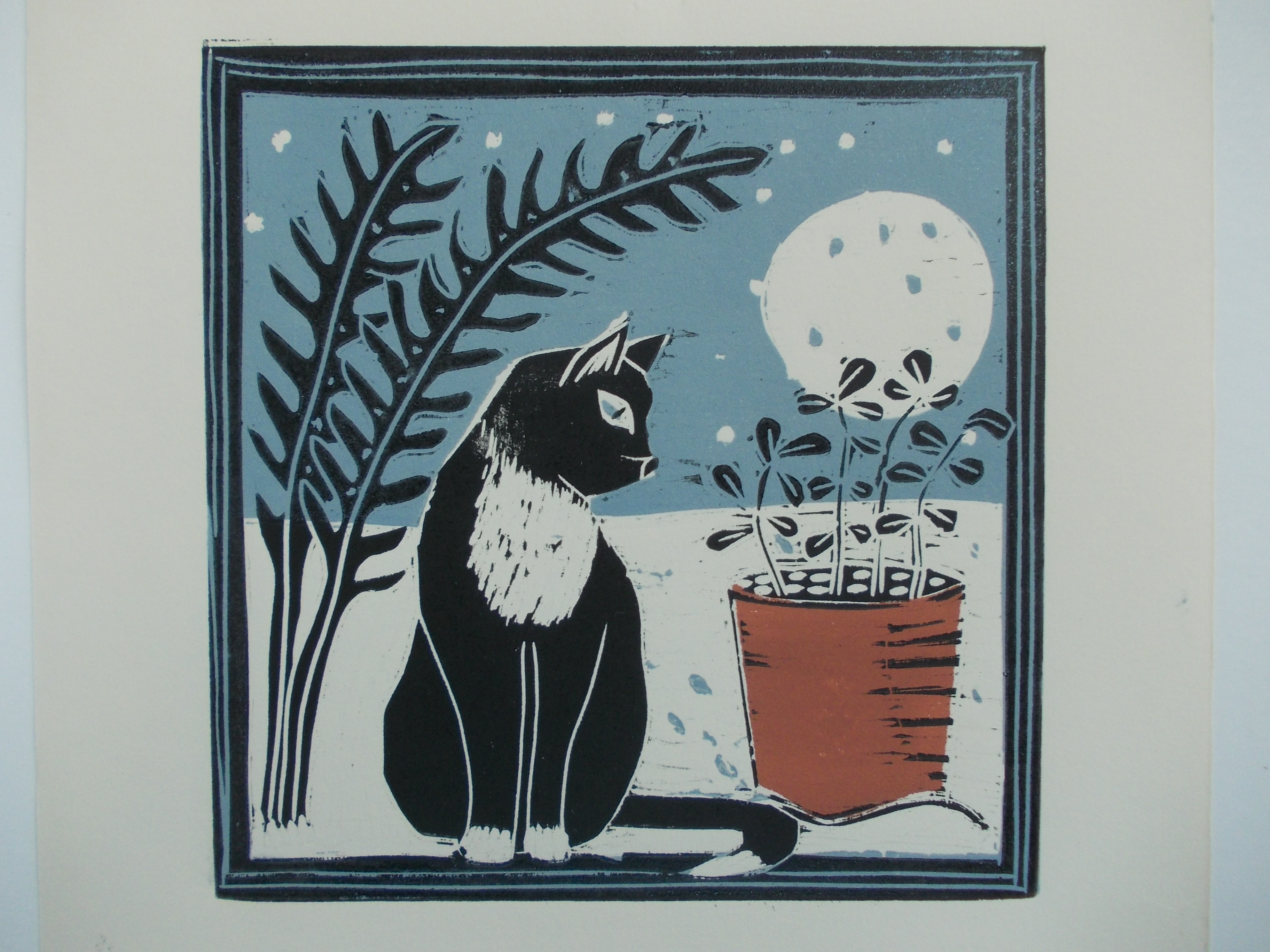
Liz: In January I received a kidney transplant after 3 years on dialysis. This was wonderful news, but has for four and more months involved many unanticipated side-effects, a cupboard full of medication and a routine of hospital visits up to three times a week. My art and craft work was not surprisingly suspended. However, in late April and into May, I was able to return to my lino printing class in Lewes. Returning to favourites I have been able to do versions of a Winter picture showing a cat in the snow and a Spring picture of a blackbird with foliage.

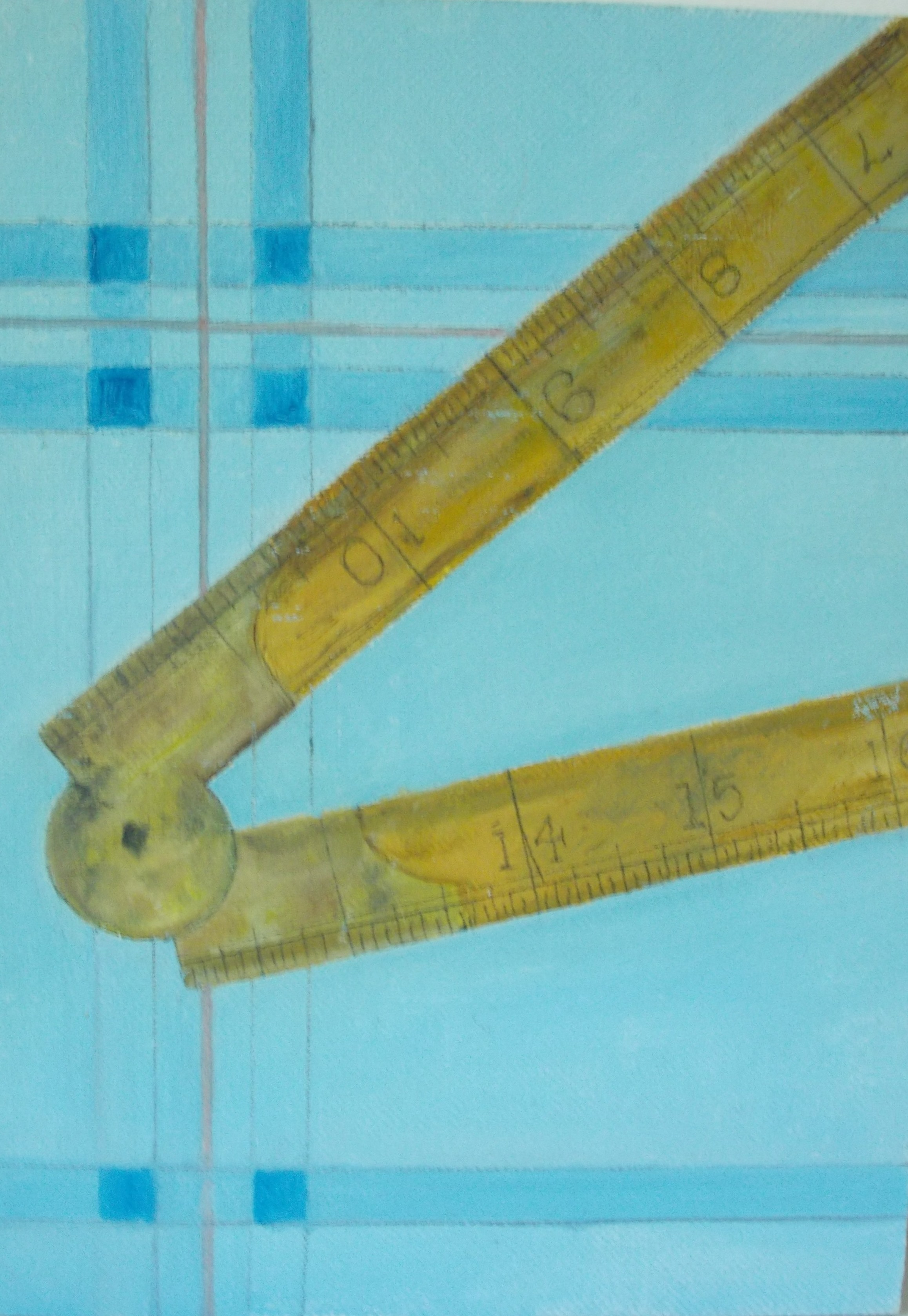
Peter: January to late April was, as Liz explains, a fallow period for us both. I barely visited the Workshop (it was also very cold) but did do some small paintings at a desk at the top of the house, chiefly of ordinary everyday objects. These are pictures of things which we tend to take for granted but which might take on some interest, whether in their structure, colour, texture or surface when we look again

There are now some 20 of these pictures (oil on 18x13cm canvasses on board. See ‘Recent Work’). I‘m thinking of combining them in one composite 4 x5 set: a sort of in praise of ordinariness.  Maybe, maybe not.

At the back of my mind, as so often, anyway, is the phrase ‘So much depends upon’ from a favourite and famous short poem by the American poet William Carlos Williams, a friend and co-worker of the painters Charles Sheeler and Charles Demuth who I mention elsewhere on this site. The poem runs:

So much depends
upon

a red wheel
barrow

glazed with rain
water

beside the white chickens.

The poem has been much discussed but for my purposes it’s a poem about a startling, illuminating moment when an ordinary, humdrum object and scene take on a special uplifting quality, in a kind of waking moment. All I need for this series to find is a red wheelbarrow glistening in the rain!

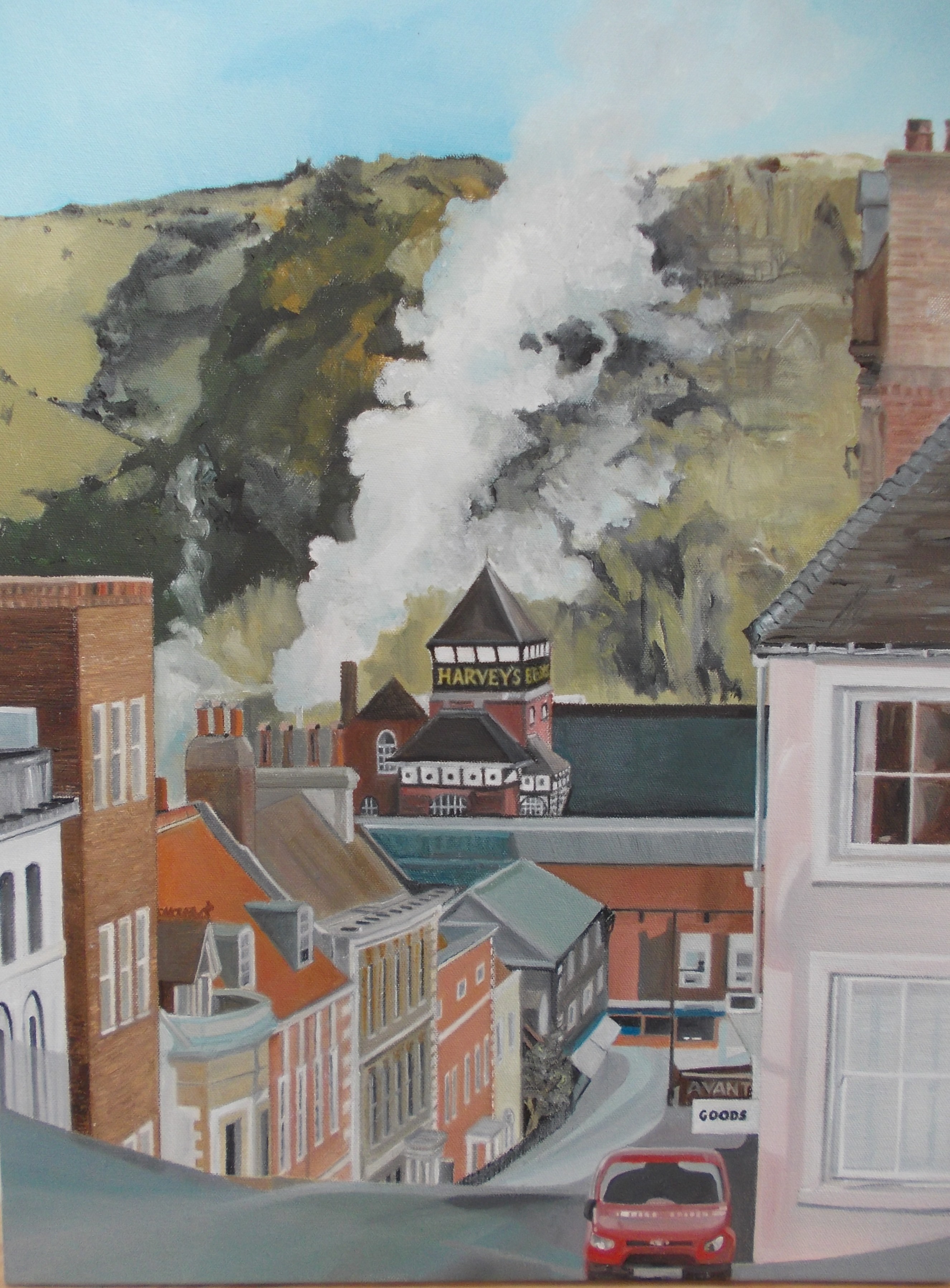
Other work by me just before and just after this fallow period for us both, are paintings of the remains of the West Pier at Brighton, a planned picture at a distance of the existing pier, a painting of Harvey’s Brewery in Lewes from the top of School Hill and one of the signal box at Lewes Station.  Each picture is a re-working of striking photographs by family members and a friend. This has become a standard practice for me and I may try something more directly abstract just to see how satisfying, or not, I would find this. I’ve become very conscious of – what seems like – the coarse surface of the standard canvas I’ve been using and am trying linen canvas or may return to board.

When not painting or wondering how to paint in this same period I’ve been reading a number of books on painting: three by John Berger (Landscapes, Portraits and Confabulations), Grayson Perry’s Playing to the Gallery,  Julian Bell’s  What is Painting?  Most are critical works on the practice and theory or philosophies of painting or drawing, over time in Berger’s Portraits and Bell’s book, as well as in Perry’s book on the cultural institutions governing taste, judgement, value (in money terms) and fame. Bell’s book is particularly careful and impressive in tracking artistic practice in relation to other cultural and critical theory (for example postmodernism and deconstruction). It is perhaps the most scholarly of these books. Perry’s is the most iconoclastic, and Berger’s the most searching and intensely felt in his reflections on art practice and most radical in his lasting adherence to a very direct and uncompromised Marxism.

I’m not sure what I’ve learned from these author/artists to advance my own taste and practice. I think maybe I was looking for some vindication of what I’ve been doing and feel drawn to in the artists I admire. They’re all open enough to allow for that (none, that is to say, are dictatorial or feel there is one way especially today for art to go).

So, carry on …

2017-18.

We have attended the following events in recent times

Three events at the Towner art Gallery, Eastbourne

July, Ravilious and Co. The Pattern of Friendship (27 May- 17 September)

This very full exhibition, which we needed to visit twice in July to fully appreciate, marked the 75th anniversary of Ravilious’s death in 1942. It documents his relationship with friends, lovers and affiliates who were also frequently his co-workers; amongst them Paul Nash, Enid Marx, Barnett Freedman, Tirzah Garwood, Edward Bawden, Peggy Angus and Helen Binyon, all of whose work is also displayed. The exhibition works chronologically through Ravilious’s own and the others work, from their time at the Royal College of Art to life at Peggy Angus’s cottage ‘Furlongs’ in East Sussex and their roles as artists in the Second World War. Most noticeably and illuminatingly, for us, it gave a strong sense of the various media these friends worked in from water colours and pencil to woodcuts and prints, book jackets and illustrations, posters, wallpaper and fabric design.

A further visit to the Towner in August for a talk Prints by Ravilious & Co. with Jeremy Greenwood highlighted the role of Paul Nash in inspiring the revival in printmaking carried forward by Ravilious, Tirzah Garwood, Douglas Percy Bliss, Edward Bawden and Enid Marx.

The book by Andy Friend Ravilious and Co. The Pattern of Friendship (2017) provides an absorbing, illustrated account of the work and networked lives of these artists from the 1920s through to the 1940s with a brief Aftermath.

Our third event at the Towner was a preview of the exhibition A Green and Pleasant Land (running until 21st January 2018) devoted principally to photography, with film and some sculpture, from the 1970s through to today. As the curator Greg Hobson explained the exhibition illustrates a governing tension between those works which view the British landscape with a social or political eye and those who bring to it a more meditative or spiritual perspective. Whereas the first show a populated landscape of people, buildings, ruins or industrial sites, the second draw attention to light, texture, mystery and a suggested transcendental ambiance. Of the fifty or so artists included we would pick out the work of John Davies whose large detailed photographs (eg ‘Agecroft Power Station’ which shows an amateur football match dwarfed by four massive cooling towers) belong firmly to the first tendency.

Soul of a Nation at Tate Modern

In October we visited the exhibition Soul of a Nation at Tate Modern; a comprehensive exhibition of ‘art in the age of Black Power’ from 1963 into the 1980s. The change in language from the use of the term ‘Negro’ (used by Martin Luther King) to ‘Black’ and to ‘Afro-American or ‘African-American’ over these decades accompanied the changes in art, as a vehicle of protest and affirmation from street art to the inspiration of African design in representational and abstract art.  12 rooms take the viewer through this complex story.

Ashdown Gallery

Also in October we visited the exhibition of work by Lorna Kirin (formerly Holdcroft) at the Ashdown Gallery, Forest Row. We had seen her work at Lewes Art Wave in 2015 and were delighted and inspired to see these new paintings – so much so that we broke the bank to buy one! Her work can be seen on the Gallery’s website: http://www.ashdowngallery.com/ or on her own website with her husband, the artist Stephen Kirin, at https://thekirins.com/lorna-kirin/

Another purchase was a small painting in oils ‘Into the clear’ by Marco Crivello.

Tate Britain

In November, we visited the exhibition Impressionists in London at Tate Britain. It was good to see the Monet but too many works were by non-impressionist French artists who chose to visit London.

Pelham House

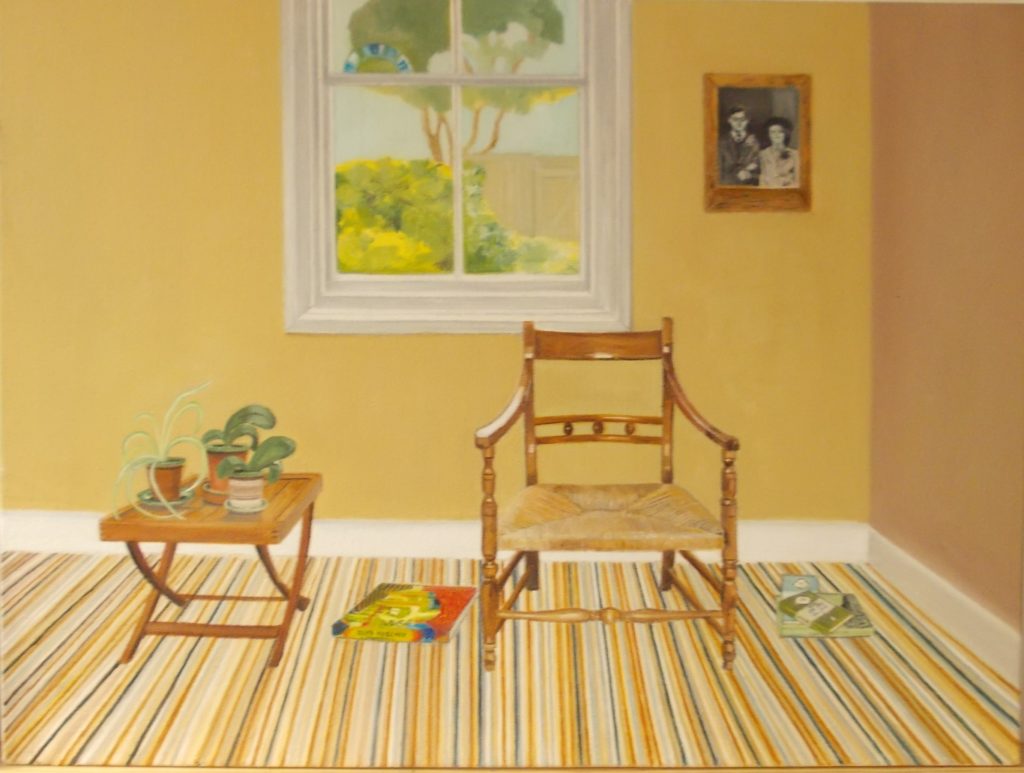
In February 2018, Peter had the painting ‘Their wedding, his books, our chair’ (below) selected for the Open Exhibition of work by Lewes’ artists held at Pelham House Hotel. The exhibition ran to the 7th March.

The Curator, Sarah Rigler deserves to be congratulated on a varied and stirring show. However, unfortunately, this is apparently to be the last Open Exhibition to be held at Pelham House.